
AI Workflow Bottleneck Detection Automation: Identify & Fix Process Delays
What Is a Workflow Bottleneck?
A bottleneck is the point in a workflow where demand exceeds capacity, causing work to slow and back up behind that step. Once that constraint forms, everything downstream moves at the speed of the bottleneck. This creates a domino effect—even if the rest of your team is productive and well-staffed, the bottleneck limits the entire operation.
A single approval step that drags on, an overloaded owner, or a messy handoff can create issues that spread across entire project timelines. The problem is often invisible to leadership. Tool switching makes that visibility problem worse. One study estimates the average worker spends about 9% of their year (nearly 200 hours) just switching between workplace apps.
Bottlenecks don't always occur where intuition suggests. The visible queue buildup often forms two or three stations downstream from the actual limiting operation, making manual detection unreliable.
How AI Detects Workflow Bottlenecks
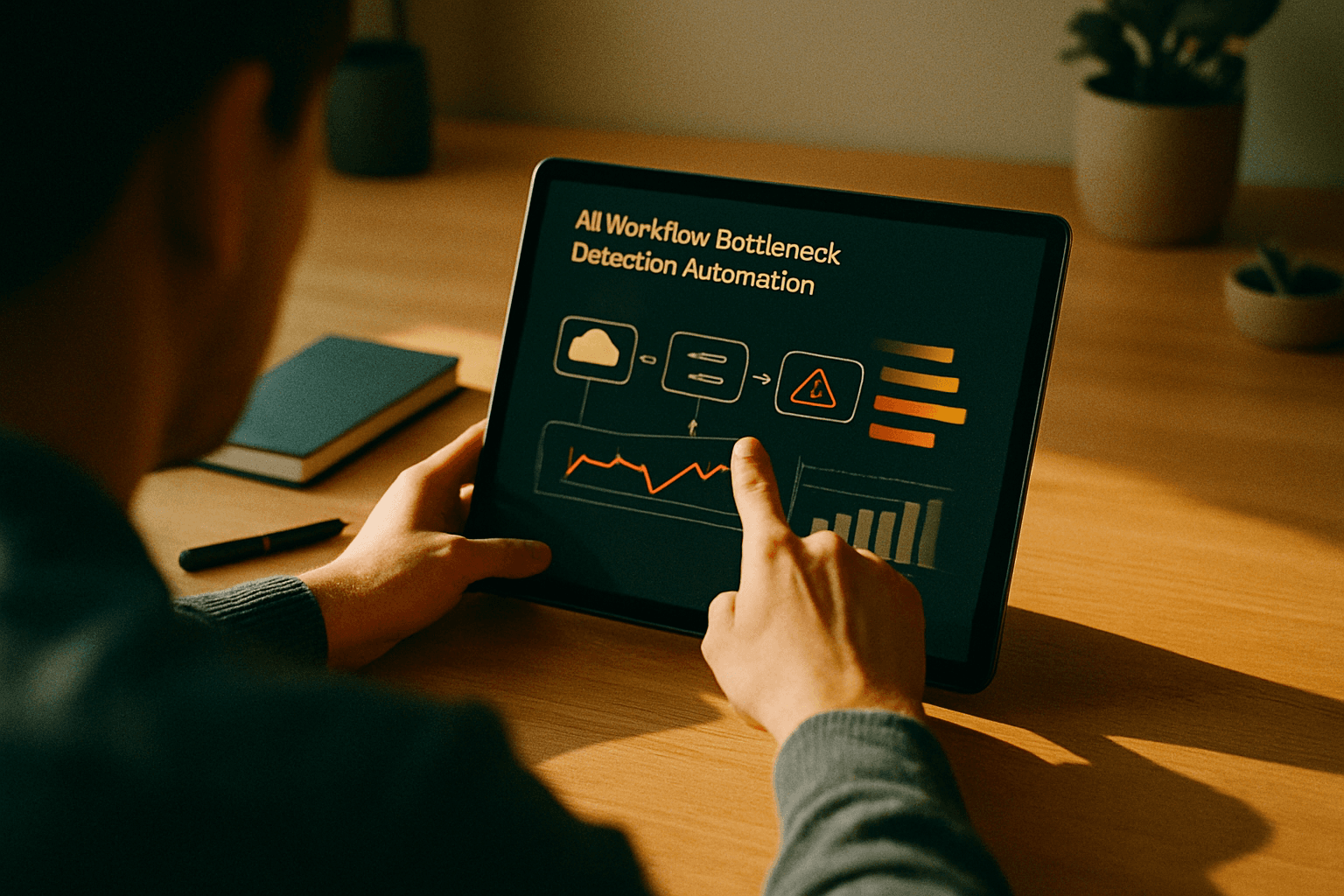
AI systems approach bottleneck detection systematically by analyzing operational signals across your workflows. AI agents detect workflow bottlenecks by combining operational signals instead of guessing. Timestamps, workflow states, messages, and system logs help identify where work gets stuck, why delays happen, and which operational fixes are needed.
Rather than one-off analysis, AI continuously monitors workflows. AI agents look for repeated delays, waiting states, reassignment patterns, manual overrides, escalation frequency, and exception clusters that show where work gets stuck.
The Data Behind Detection
Machine Learning Models use supervised learning algorithms to analyze historical production data to predict bottlenecks based on past patterns. Unsupervised methods uncover hidden constraints in complex processes without requiring pre-labeled data.
Real-time anomaly detection allows AI models to identify anomalies in incoming data, like a sudden drop in web traffic or a spike in failed transactions, and alert or halt the workflow before it corrupts downstream insights. This proactive capability means you catch problems before they create cascading delays.
Predictive workflow optimization allows AI to forecast processing slowdowns, workload spikes, or dependency issues and proactively rebalance resources to prevent failures or bottlenecks.
From Detection to Root Cause Analysis
Identifying where a bottleneck exists is just the first step. Automated root cause analysis allows AI to pinpoint where a failure originated and its impact, saving data teams hours of troubleshooting.
Advanced systems combine AI with "smart debugging" tools at the software code level to trace performance issues at a very granular level. AI can identify inefficiencies in how different software modules communicate, which is invisible to managers focused only on high-level process flow. By drilling down into system logs and even application code execution, these tools isolate the root cause and suggest a solution.
This level of granularity matters because apparent bottlenecks often mask deeper issues. A slow approval queue might actually stem from missing data earlier in the workflow, or poor system integration creating manual rework.
How AI Identifies Automation Opportunities
Once AI detects bottlenecks, the next step is recognizing which ones can be automated. This isn't obvious—not all bottlenecks benefit from automation.
AI tools automatically pinpoint bottlenecks, redundant steps, rework loops, excessive approvals, and waiting times across your processes, so you know exactly where time, effort, and cost are being wasted. It can also recommend high improvement value points and areas where automations can give the highest impact to avoid delays.
AI can suggest optimization opportunities: if it notices that two departments perform redundant data entry, it might recommend automating that step or integrating the systems. Tasks that occur daily, weekly or monthly are prime candidates for automation. Streamlining these repetitive processes not only saves time but also ensures accuracy in data handling.
The AI doesn't just flag inefficiencies—it assesses them. Value assessment is a business evaluation that examines whether and how much an automation benefits a company and its employees. Mining techniques can be used to gain insight into the current process execution based on the analysis of historical data. Process mining builds on the analysis of event logs to provide an understanding of the overall process.
Why Traditional Approaches Fall Short
The old way of finding bottlenecks relied on management observation, employee feedback, and manual process mapping. Traditional bottleneck identification depends on manual data gathering to map time-consuming processes and requires significant time spent analyzing data from multiple systems, often requiring technical expertise. Insights are delayed, as issues are identified only after they have already impacted performance.
Traditional workflows follow static rules. AI-powered ones learn from past patterns, adapt in real time, and prioritize fixes based on business impact—not just technical errors.
Real-World Impact
The adoption of AI workflow automation is accelerating rapidly. A 2025 McKinsey industry study highlights a significant shift toward agentic AI-powered solutions, with enterprises increasingly investing in workflow automation platforms to enhance productivity and decision-making.
The ROI can be substantial. Companies using AI for marketing automation see 14.5% increase in sales productivity. For support teams, the gains are even starker—a SaaS startup reduced support backlog by 40% by integrating AI agents.
Getting Started With Bottleneck Detection
Keeping a human in the loop for reviewing AI-driven recommendations is a good safety check. Also, maintain transparency with employees: if you're monitoring workflows, let teams know what is being tracked and how it's used, to build trust.
Companies that lead in this space often have cross-functional teams that continuously look for improvement opportunities. They treat the AI tool as a partner in decision-making.
The transition from detection to action matters too. AI bottleneck identification automates the heavy lifting of analysis and frees process analysts or BPM teams to shift their focus to taking actions rather than finding issues.
The Bottom Line
AI workflow bottleneck detection transforms process improvement from reactive troubleshooting into proactive optimization. By automatically identifying where work slows down, why it slows down, and where automation delivers the most value, AI systems enable businesses to reclaim lost productivity and redirect resources toward strategic work.
The technology exists. The question now is whether your organization will use it to get ahead of bottlenecks—or continue discovering them after they've already cost your business time and money.