
Best AI Test Generation Tools for Developers in 2026
The Problem: Test Maintenance Eating Your QA Budget
Teams shipping daily face a persistent challenge: test suites that break every time a developer renames a button or restructures a form. QA teams spend 20–30% of their bandwidth fixing brittle locators rather than building new coverage. Traditional test automation tools like Selenium and Cypress require developers to write and maintain test scripts manually, leaving teams spending up to 60% of their time maintaining existing tests rather than writing new ones.
AI test generation tools exist to solve exactly this problem. According to a survey of 625 software developers, 81% of teams now use AI tooling in their testing workflows for test planning, test management, test writing, and analyzing test results.
Understanding AI Test Generation Categories
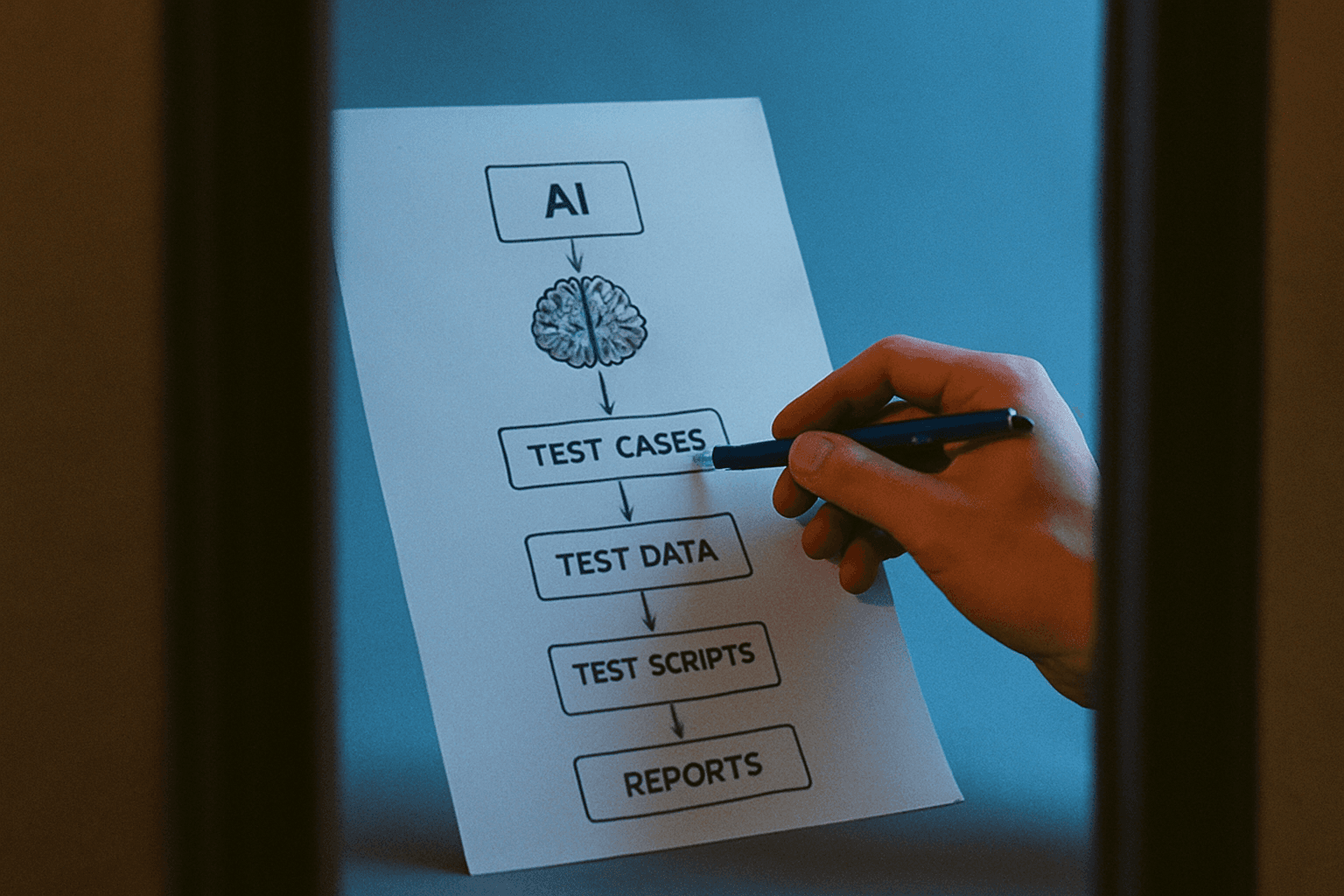
Generation is how a test comes to exist—from natural language, specs, or traffic. Automation is the running and maintenance of it. The best 2026 platforms do both in one loop: generating from natural language, then self-healing in execution.
A tool that generates Playwright steps is not automatically a good fit for a team that needs reviewable manual test cases with expected results and requirements traceability. The best choice depends on what you want the AI to produce and where that output needs to live.
Leading Agentic Testing Platforms
Mabl: AI-Native Test Automation
Mabl stands out as a mature AI-native platform. Its agentic tester uses multiple AI technologies to autonomously update tests, eliminating up to 95% of test maintenance and keeping your team in flow.
Key features include:
- Auto-healing: Keeps tests passing through non-breaking UI changes
- Intelligent waits: Eliminates timing flakiness by ensuring each step waits for the page and element to be ready before acting
- Visual detection: Catches regressions that text checks miss
- API-based setup: Fast test creation with clean UI and useful reporting dashboard
Applitools: Visual AI Testing at Scale
Applitools specializes in visual testing, combining proven Visual AI with GenAI and no-code approaches to maximize test coverage while automating maintenance.
Unlike traditional pixel-based tools, Applitools Eyes uses advanced AI and machine learning to handle dynamic content and identify meaningful visual changes without false positives. The product line includes:
- Eyes Validator: De facto standard for visual AI testing across web, mobile, and desktop
- Ultrafast Grid: Cross-browser execution
- Native Selectors: Self-healing locators
- Accessibility checks: Built into the unified platform
The Applitools Eyes MCP Tools, Figma Design Baseline SDK integration, and Intent-Based NLP engine are available starting September 15, 2026.
Virtuoso QA: Enterprise-Scale Autonomous Testing
Virtuoso QA represents the category-defining AI-native platform architected entirely around generative AI and LLM capabilities. Unlike tools that add AI features to legacy frameworks, Virtuoso QA was built from inception to deliver autonomous testing at enterprise scale.
Capabilities include:
- Autonomous test generation from requirements, wireframes, legacy suites, manual test cases, Jira stories, or Figma designs
- Natural language programming to create tests by describing user actions in plain English with LLM-powered intelligent autocomplete
- StepIQ: Analyzes application structure and generates test steps, assertions, and edge case scenarios automatically
- AI test data generation
- 95% self-healing capabilities
API-First Test Generation
Keploy: Automatic API Test Generation
Keploy is an open-source API testing platform that automatically generates test cases and data mocks from real API calls. Instead of asking developers to write tests manually, Keploy captures real API traffic from your running application and automatically generates test cases and mocks from that traffic.
Every real request and response pair becomes a test—complete with realistic data and observed behavior. Recent updates include intelligent edge case and failure test generation, automatically creating tests for boundary conditions, invalid inputs, error states, and failure modes.
Managed Testing Services
QA Wolf: Fully Managed E2E Testing
QA Wolf offers a different model: a managed service combining software, AI tooling, and human QA engineers that promises to build and maintain end-to-end test coverage for your web application within a few months. You don't write the tests, you don't fix the flakes—you receive a maintained Playwright suite and a stream of verified bug reports with 100% parallel execution.
Two pricing options:
- Platform option: Your team automates and maintains tests using QA Wolf's AI and infrastructure as self-serve tooling at 1¢ per AI credit and 15¢ per runner minute. Suited for teams that want hands-on control.
- Coverage as a Service: QA Wolf's team builds, runs, investigates, and maintains your entire end-to-end suite with guaranteed coverage, zero flakes, and human-verified bug reports. Suited for teams that want QA completely off their plate.
Test Management with AI Assistance
Testmo: AI Test Case Generation Within Requirements
For teams wanting AI-assisted test case generation within a test management system, Testmo introduced AI Test Case Generation in February 2026. The workflow starts inside the test repository by supplying requirements, reviewing and refining suggested cases, choosing which suggestions to keep, and generating final cases in text, step-based, or BDD format.
Generated cases are tagged as AI-created and linked back to their originating requirement, making Testmo especially relevant for teams that want AI assistance without losing the connection between requirements, test design, execution, and coverage reporting.
TestRail: AI-Powered Case Generation
TestRail has AI-powered test case generation allowing teams to input requirements and generate structured test cases. The AI is designed to assist, not automate blindly, and includes admin controls for governance.
Developer-Centric Tools
GitHub Copilot: IDE-Integrated Test Generation
GitHub Copilot isn't a dedicated testing tool, but its test generation has matured significantly in 2026. It analyzes surrounding files and patterns to generate unit, integration, or E2E test examples that live directly in your repository, integrating with VS Code, JetBrains, and other major IDEs.
Qodo: Unit and Integration Test Generation
Qodo (rebranded from CodiumAI) solves a different problem than other tools on the list by generating unit and integration tests rather than browser-based E2E tests. Qodo Gen analyzes your code and generates test cases that cover edge cases, boundary conditions, and error paths, working inside VS Code and JetBrains IDEs to generate tests as you write code.
Choosing the Right AI Test Generation Tool
Team fit matters as much as features. Developer-led teams often prefer code-first tools while cross-functional teams benefit from low-code collaboration. Tools generally fall into three groups:
- Code-first frameworks: Best for engineering teams with development expertise
- Hybrid or low-code platforms: Balance automation with human oversight
- AI-native tools: Built to reduce maintenance over time, ideal for teams with limited QA resources
The right choice depends on your release velocity, team structure, and whether you need full autonomy or human oversight in the testing process. For teams shipping daily with AI coding agents, autonomous generation becomes essential. For teams balancing velocity with governance, AI-assisted generation with review workflows offers the best balance.
Reduced maintenance in AI testing frameworks can eliminate the need to manually update locators for every minor UI change, reducing maintenance effort by up to 85% and making it easier to maintain automated tests over time. The 2026 landscape offers solutions for every approach—the key is matching the tool's architecture to how your team actually works.