
Best E-Reader 2026: Kindle vs Kobo vs Boox Compared
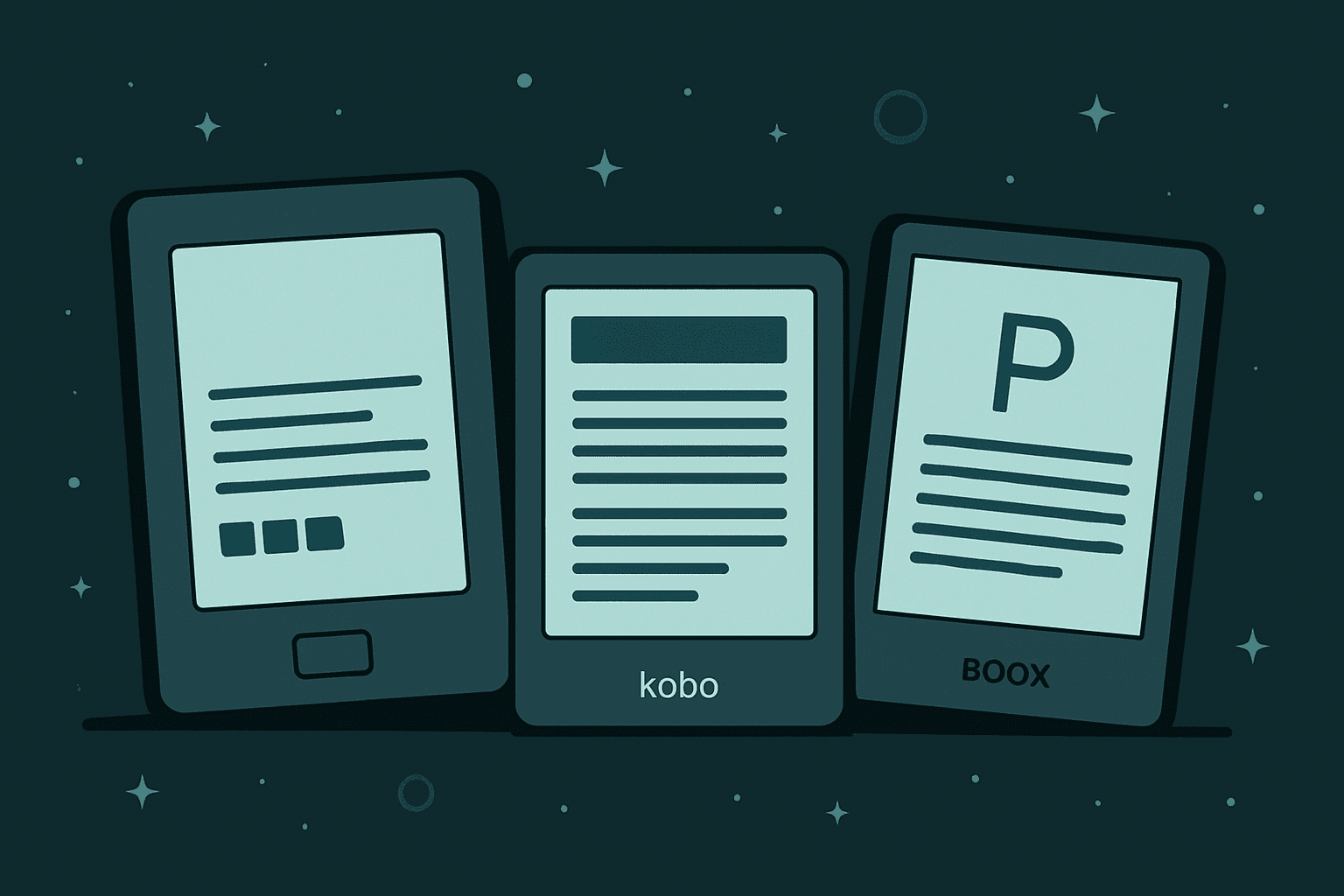
If you read constantly, the e-reader you choose shapes your reading life for years. It decides which store you buy from, which library apps you can use, and whether you're reading in crisp black-and-white or full color. In 2026, the choice really comes down to three camps: Amazon's Kindle, Rakuten's Kobo, and the Android-powered Boox lineup. Each is built for a different kind of reader. Here's how they stack up and which one fits you.
The Quick Verdict
- Kindle is the easiest, most frictionless option, especially if you buy books from Amazon and want a device that just works.
- Kobo is the reader's reader: excellent library integration, open EPUB support, and color models at competitive prices.
- Boox is for tinkerers who want a full Android device that can run Kindle, Kobo, and dozens of other apps on one screen.
Kindle: The Default That's Hard to Beat
Amazon's lineup got a full refresh, and the Paperwhite is still the sweet spot for most people. The Kindle Paperwhite (2024) is the 12th-generation e-reader from Amazon, starting at $160 for the base model, which comes in three colors: Black, Jade, and Raspberry. It uses a 7-inch display with a built-in light, 300 ppi, and 16-level grayscale, with up to 12 weeks of battery life and a waterproof design. If you want to spend less, the ad-supported standard Kindle runs $109.99, roughly $50 cheaper than the Paperwhite. Amazon nudged prices up across the board — the entry-level model now sells for $110 and up, $10 more than the 2022 version, while Paperwhite pricing rose from $140 in 2021 to $160 for 2024.
Amazon also finally added color. The Kindle Colorsoft Signature Edition packs a 7-inch color display designed specifically for reading, a waterproof build, USB-C, wireless charging, up to eight weeks of battery life, and an auto-adjusting front light. Amazon has since broadened the range: the Kindle Colorsoft with 16 GB is available at $249.99 with three months of Kindle Unlimited included, the Signature Edition at $279.99, and a Colorsoft Kids version at $269.99.
For note-takers, the big-screen Scribe is the flagship. The Kindle Scribe with a front light starts at $499.99, and the newer Kindle Scribe Colorsoft starts at $629.99, both offering weeks of battery life.
The catch with Kindle is the walled garden. Amazon's devices don't read EPUB — the world's most common e-book format — natively. You can send EPUBs (DRM-free), PDFs, DOC/DOCX, RTF, TXT, and HTML through Send to Kindle, but the device converts them to Kindle formats like KFX or AZW3 for actual reading. In practice, that means library books and files with DRM from outside Amazon's store are a hassle. If your reading lives inside Amazon, none of this matters. If it doesn't, it's a real limitation.
Kobo: Built for People Who Actually Use the Library
Kobo is the brand serious readers keep recommending, and library support is the reason. Kobo added OverDrive support across its current models, letting you add your library card and borrow free e-books directly on the device wirelessly, without a computer or Adobe Digital Editions. Because Kobo handles EPUB and its own KEPUB format openly, borrowing and sideloading are far smoother than on Kindle. That single feature makes Kobo the natural pick for anyone who leans on public libraries.
Kobo also jumped into color. Rakuten Kobo introduced its first color E Ink readers — the Libra Colour and Clara Colour — using a Kobo-optimized color E Ink Kaleido 3 display, alongside a black-and-white Clara BW. In the US, the Libra Colour retails for $229.99, the Clara Colour for $159.99, and the Clara BW for $139.99. The Kaleido 3 panel is a sensible compromise rather than a magic bullet — the screens run at 300 ppi in grayscale but drop to 150 ppi when displaying color. On the hardware side, the Libra Colour adds a faster processor and stylus compatibility, and all three devices are IPX8 water-resistant with USB-C, Wi-Fi, Bluetooth, and Kobo audiobook playback.
Audiobook fans should note the ecosystem is Bluetooth-only and Kobo-based. Kobo's audiobook-capable models — including the Clara Colour, Libra Colour, and Clara BW — play audiobooks through paired Bluetooth headphones or speakers.
If you want to write as well as read, Kobo's big-screen option targets the Scribe directly. The Kobo Elipsa 2E has a 10.3-inch FHD E Ink display and 32GB of storage, aimed squarely at the note-taking crowd. It sells for $400 in the US, competitive pricing against the Kindle Scribe and reMarkable 2.
Boox: The Power User's Wildcard
Boox takes a completely different approach. Instead of a locked-down store, its devices run full Android. Because Boox devices run Android, they open up a world of apps a Kindle or Kobo simply can't touch, staying compatible with most titles in the Play Store. That means you can install the Kindle app, the Kobo app, Libby, and more on a single reader — a genuinely different value proposition.
The standout for book lovers is the phone-sized Palma. The original Palma has a 6.13-inch screen with a 2:1 aspect ratio, a Carta 1200 display, an 8-core processor, 6GB of RAM, dual-band Wi-Fi, and Bluetooth 5.0. Its pocketable shape makes it feel like a distraction-free phone that only reads. The successors push further: the Palma 2 added Android 13, a better processor, and a fingerprint sensor, starting at $280. There's now a color, LTE-capable version too — the Palma 2 Pro launched in the US at $400 with a 6.13-inch Kaleido 3 color E Ink screen reproducing 4,096 colors. Reviewers note it runs Android 15 with the Google Play Store, a Snapdragon 750G, a fingerprint scanner, a front light, and a SIM tray that doubles as a microSD slot.
For a larger canvas, Boox offers color tablets. The Note Air 4C features a 10.3-inch color E Ink display optimized for note-taking and colorful content like comics and magazines.
Boox's flexibility comes with trade-offs. The devices can feel overbuilt for pure reading, and the color panels demand fiddling with the front light. As one reviewer put it, the Palma 2 Pro weighs just 175g but costs $130 more than the Palma 2, and Boox "seems to have forgotten this is an e-reader first and Android device second." If you want to tweak settings and juggle apps, that's a feature. If you want to open a book and read, it's friction.
How to Choose
Pick a Kindle if you buy from Amazon, want the least fuss, and value a mature, reliable experience. The Paperwhite is the mainstream champion; the Colorsoft is worth it only if color matters to you.
Pick a Kobo if you borrow from libraries, want open EPUB support, or want color at a lower entry price. It's the best fit for the reader who owns a stack of DRM-free files and a library card.
Pick a Boox if you want one device to rule them all — Kindle app, Kobo app, note-taking, and web browsing on E Ink. Just go in knowing it asks more of you in setup and price.
For most avid readers in 2026, the honest answer is Kindle for convenience or Kobo for freedom. Boox is the enthusiast's choice — brilliant when you want control, overkill when you just want to disappear into a good book.