
Best Voice Assistant for Smart Home Control: Alexa vs Google vs Siri
Device Compatibility: Quantity vs. Quality
When hunting for the best voice assistant for smart home control, device compatibility is often the deciding factor. The gap between platforms is significant.
As of 2024, Apple lists over 1,000 devices compatible with Apple Home, compared to 10,000 for Google and 85,000 for Amazon. This dramatic difference means Alexa users have vastly more options when building a smart home, but it also introduces complexity—managing devices from many different manufacturers can require more setup and troubleshooting.
Alexa supports the widest range of third-party smart home devices. Popular platforms like Philips Hue, August locks, and Ecobee thermostats all work with Alexa, often with more natural voice control than competitors. Alexa dominates smart home control with over 100,000 compatible devices.
Google Assistant takes the middle ground. Google Assistant can control lights, plugs, switches, thermostats, and more, with hundreds of devices compatible with the technology, including smart thermostats, lights, cameras, and locks, among many others. Google's Smart Display is designed to connect seamlessly with your smart home, supporting 40,000 devices.
Apple's HomeKit ecosystem is far more selective. HomeKit is built into all Apple devices and is controllable with Siri, but the product range is smaller than rivals. This curated approach means fewer choices but often higher build quality and better integration with Apple's own products.
Voice Command Accuracy and Natural Language Processing
Not all voice assistants understand commands equally well. Testing reveals meaningful differences in how accurately each interprets what you're asking.
Google Assistant led in overall command accuracy at 93.2%, followed by Alexa at 89.8%, and Siri at 84.6%. Google's advantage was most pronounced in natural language understanding — it correctly interpreted "It's too bright" and adjusted the nearest light 78% of the time, compared to 61% for Alexa and 42% for Siri.
For basic commands, the gap narrows. For simple device commands ("Turn on the kitchen light"), all three were within 2% of each other — 97% for Google, 96% for Alexa, 95% for Siri. Where the assistants truly diverge is in complex scenarios. Multi-device commands succeeded 91% on Google, 87% on Alexa, and 79% on Siri. Conditional/routine commands succeeded 88% on Alexa (which has the most mature Routines feature), 85% on Google, and 71% on Siri.
Automation and Routines
If you want your smart home to handle complex automations—like adjusting your thermostat and closing blinds when you leave for work—the capabilities vary significantly.
Alexa excels here. Alexa has the most mature Routines feature, allowing users to build multi-step automations with delays and conditional logic. Google Home routines cover common scenarios (arriving home, leaving, bedtime, morning) well but offer less granular conditional logic than Alexa Routines; there is no equivalent to Alexa's ability to insert multi-step delays and branching conditions inside a single routine.
Apple's automation system lags further behind. Siri's set of recognized smart home commands is the smallest of the three platforms, Scenes in the Apple Home app are simpler than Alexa Routines or even Google Home routines, and a long list of popular smart home brands, particularly budget WiFi brands common on Amazon, still ship no HomeKit support at all.
Privacy and Data Handling
Privacy concerns have become increasingly important to smart home users. The three platforms take distinctly different approaches.
Apple positions Siri as the more privacy-focused option. Google and Amazon collect more cloud data to power features. They have added more privacy settings over recent years, including options to manage voice recordings and limit data sharing, but they still rely more on cloud processing than Apple.
A meaningful share of voice processing for on-device requests happens locally rather than being sent to a cloud server, and Apple's Home app stores automation logic and device state with end-to-end encryption when synced through iCloud. In contrast, Alexa stores detailed information about your connected smart home devices.
User perception reflects these differences. User trust metrics reveal significant disparities in voice assistant privacy perceptions: 28% of users consider Amazon's Alexa the least secure platform, compared to 24% who express equal distrust toward both Google Assistant and Siri. Apple Siri and HomePod offer robust privacy defaults, like on-device processing for some tasks, while Google Assistant provides granular data control.
Matter Protocol and Cross-Platform Control
The emergence of Matter, an open connectivity standard, is changing the smart home landscape. Matter is a universal smart home standard developed by the Connectivity Standards Alliance (CSA) that lets devices from different manufacturers communicate across Apple Home, Google Home, Amazon Alexa, and Samsung SmartThings.
All major platforms support Matter, including Apple Home (formerly HomeKit), Google Home, Amazon Alexa, and Samsung SmartThings. Today, you buy a Matter device, scan a QR code and it works in Apple Home, Google Home, Alexa, or Samsung SmartThings. This flexibility means your Matter smart bulb can be controlled through Apple Home, Google Home, and Alexa at the same time.
Matter-enabled Echo devices now support the Matter 1.5 protocol. For users tired of vendor lock-in, investing in Matter-compatible devices offers genuine platform flexibility going forward.
Echo and HomePod Hardware Options
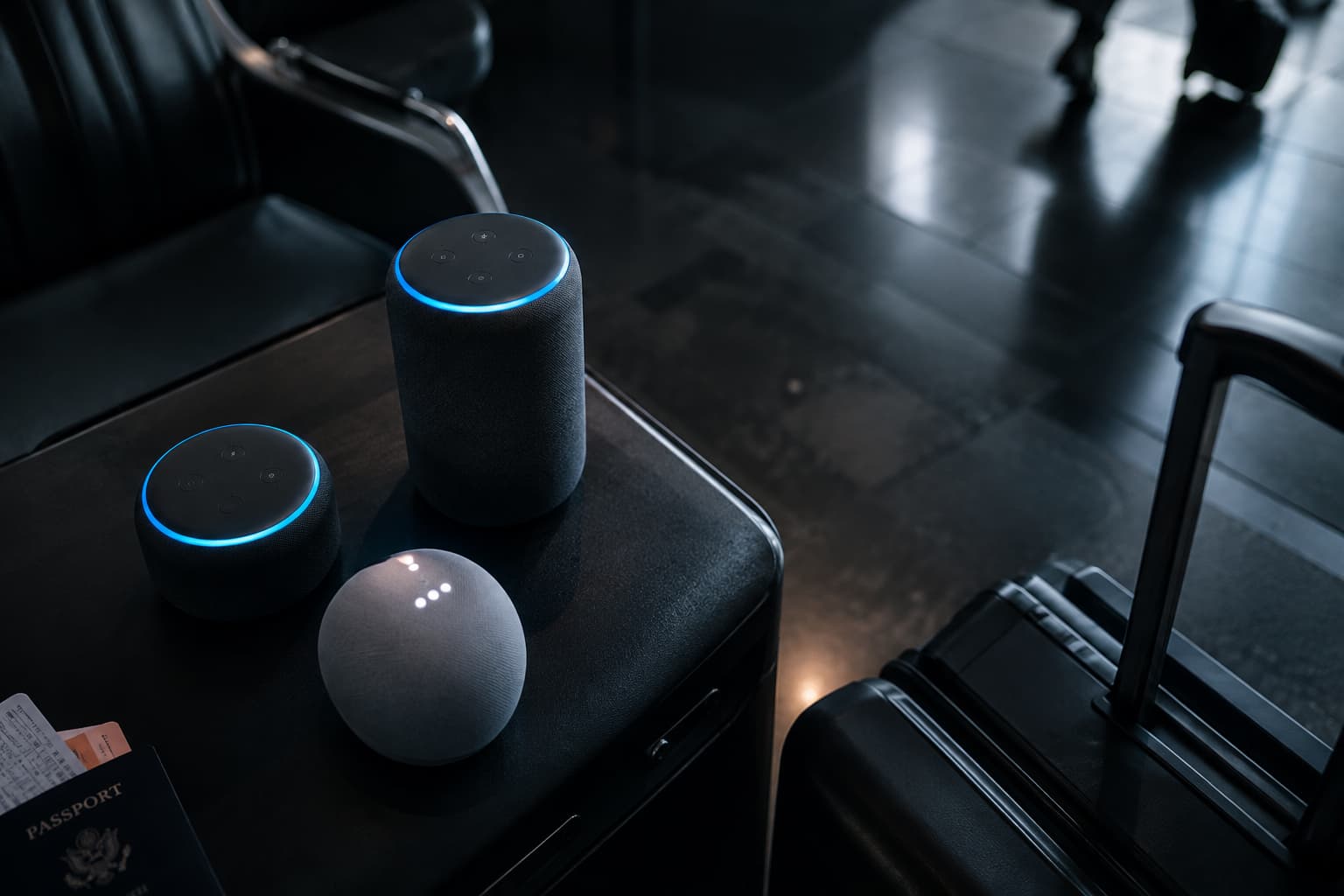
Each platform offers different hardware ecosystems. Amazon continues to offer a wide range of Echo speakers and smart displays, many of which now support Matter and Thread protocols for smart home compatibility. Amazon's lineup includes budget-friendly options alongside premium models.
The Google Nest Hub Max is a smart hub device that allows users to easily control their home hands-free with voice commands integrated with Google Assistant. The Google Nest Hub Max is the smart control center your home needs. You can connect all your smart home devices to the Nest Hub Max to easily control everything within your home with simple voice commands.
If you set up your HomePod, HomePod mini, or Apple TV as a home hub, you can use Siri to control your home from just about anywhere. If you use the HomeKit ecosystem or want to start, HomeView is a useful device that's more capable than a speaker, and the $299 price tag could be worth it. The new $149 HomePod mini will also offer Siri AI support if you want a more affordable option, but it does not have a display.
Which Assistant Should You Choose?
Your best choice depends on your priorities and existing tech ecosystem.
Smart home enthusiasts should consider Alexa for the widest support and most flexible routines. If you need maximum device compatibility and advanced automation, Alexa is the practical choice. Android users should consider Google Assistant for smart AI and device compatibility. Google excels if you already use Google services and Nest products.
Choose Siri and HomeKit if you prioritize privacy and use Apple devices. Many find Apple's smart home platform easier to manage and appreciate its speed since HomeKit processes your data locally instead of in the cloud.
Going forward, Matter works across different platforms — such as Alexa, Siri and Google Gemini (née Assistant) — and allows devices to be controlled even if internet access goes out. Starting with Matter-compatible devices gives you flexibility to switch platforms or run multiple assistants without being locked in.
The smart home voice control landscape has matured significantly. While Alexa still dominates in raw compatibility and automation depth, Google offers the best natural language understanding, and Siri provides the strongest privacy protection. The right choice for you depends on your existing devices, comfort with each platform's interface, and whether privacy, automation capability, or device choice matters most.