
Curved vs Flat Gaming Monitor: Which Gives You the Competitive Edge?
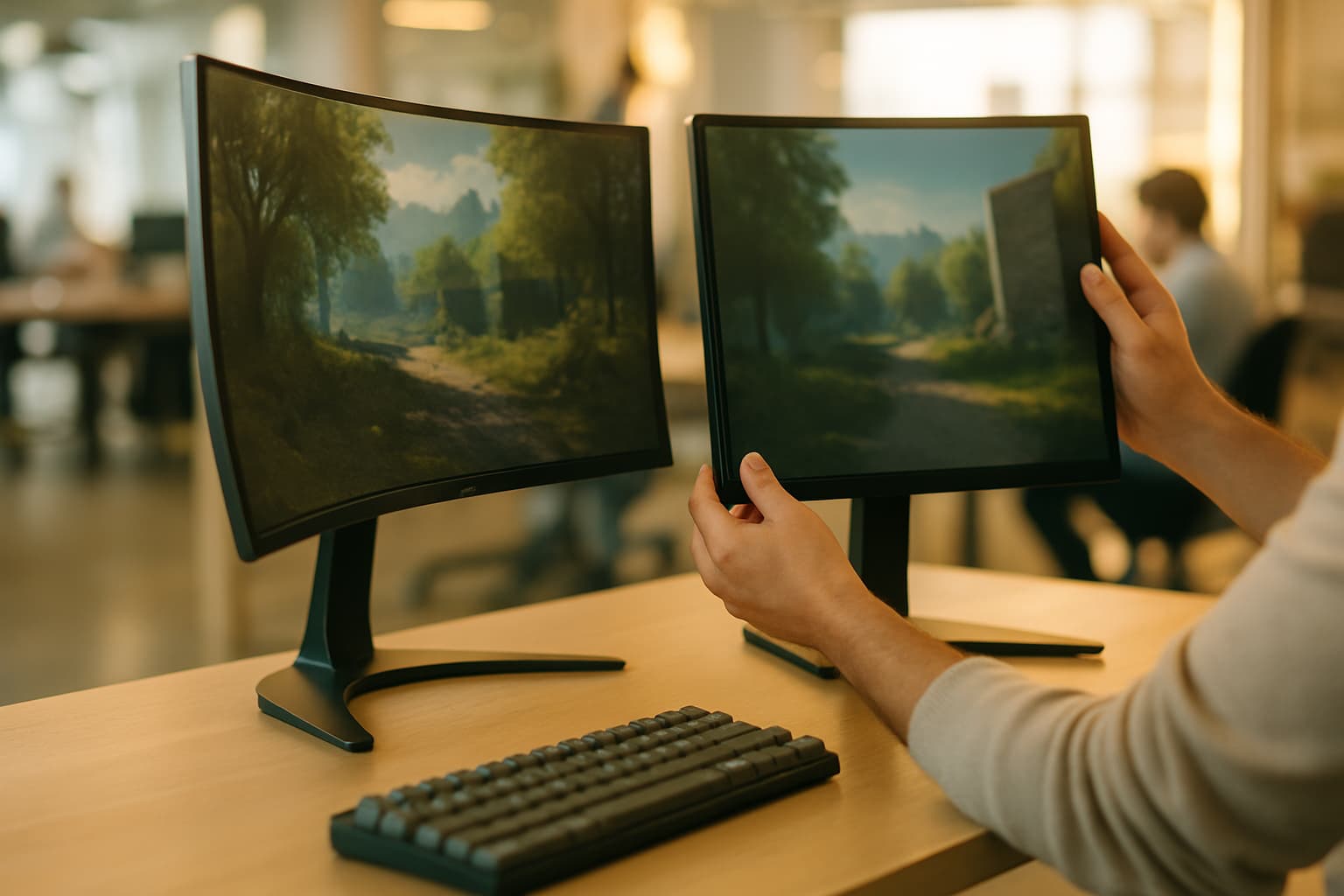
Curved vs Flat Gaming Monitors: Which Gives You the Competitive Edge?
The monitor you choose shapes your entire gaming experience. But the decision between curved and flat panels isn't simply about personal preference—it's about matching the right display to your specific gaming habits, competitive goals, and available space. Both formats offer genuine advantages, and understanding where each excels helps you make an informed choice.
The Immersion Question: Where Curved Monitors Win
The primary argument for a curved display is immersive depth. When a monitor curves toward you, the edges feel naturally integrated into your peripheral vision rather than receding away. For open-world games, flight simulators, and racing titles, this creates a more enveloping experience that flat panels simply can't replicate.
A curved screen places every part of the display at approximately the same distance from your eyes, reducing the need to refocus as you look across a wide display. This is particularly relevant on larger screens — a 32-inch flat monitor can have a noticeable distance difference between the center and the corners.
However, immersion isn't automatic. Curvature makes the most significant difference in immersion and eye comfort at larger screen sizes. On a monitor of less than 30 inches, many gamers find that the difference between a curved and flat monitor is relatively minimal. For most gamers, the minimum curve that reliably feels more immersive than flat is about 1800R, especially once you reach 27 inches or move into 34-inch ultrawide territory.
Competitive Gaming: The Flat Monitor Advantage
When milliseconds matter, flat monitors dominate the competitive gaming scene. Flat monitors are available at the highest refresh rates (360Hz–500Hz) across a wider range of price points. Flat 24–27 inch gaming monitors offer the best combination of pixel density, refresh rate, response time, and price for competitive titles.
Pro gamers seek monitors with response times of 1 ms or less to ensure optimal performance during competitive gameplay. Flat monitors provide consistent image quality across the entire screen, ensuring that all elements on the display are sharp and clear. This uniformity allows pro gamers to rely on their peripheral vision while playing, which can be crucial in fast-paced games where every second counts.
For competitive FPS/esports games, curved monitors are not ideal and can introduce subtle visual distortion that affects precision aiming. Flat monitors provide a distortion-free, geometrically consistent image critical for accuracy.
Eye Strain and Ergonomics
One of curved monitors' often-overlooked benefits involves comfort during extended sessions. A study conducted by researchers at the Schepens Eye Research Institute/Harvard Medical School found that participants reported significantly less eyestrain, difficulty focusing, and blurred vision when using curved monitors compared to flat screens during intensive visual search tasks.
Extended gaming sessions can lead to eye strain and fatigue, but curved monitors can help alleviate these issues. The curvature of the screen helps maintain a consistent focal distance, which reduces eye fatigue by allowing your eyes to relax.
Color Accuracy and Content Creation
If you're doing work alongside gaming, flat panels have a clear edge. Flat IPS and OLED panels deliver more consistent color across the entire screen surface compared to curved alternatives. While curved monitor manufacturing has improved significantly, perfectly uniform color across a curved panel remains more difficult to achieve than on a flat screen — particularly for content creation work where color accuracy matters.
Multi-Monitor Setups and Desk Space
Building a dual or triple monitor setup is considerably easier and more visually coherent with flat screens. Curved monitors placed side by side face outward at the edges, creating awkward gaps and uneven sightlines. For streamers and productivity-focused gamers, flat monitors' compact and space-efficient design makes them ideal for gamers with limited desk space, and they fit more naturally into multi-monitor setups, offering a seamless viewing experience across multiple screens.
The Cost Factor
Flat monitors usually come at a lower price point than curved monitors. If you're on a budget and the features of a curved monitor aren't a high priority for you, going with a flat gaming monitor can definitely save you some cash.
Refresh Rate and Response Time: The Universal Advantage
An important note: High refresh rates (144Hz or higher) and low response times are universal traits that enhance gaming performance, regardless of screen shape. A curve that does not change frame rate or latency should never be chosen in isolation. If your monitor tops out at 60 Hz, the curve may look dramatic while motion still feels ordinary. For actual gameplay feel, refresh rate and response time still matter more in fast shooters.
Making Your Choice
Curved monitors are better for immersive single-player gaming and ultrawide setups, with enhanced FOV, reduced eye movement, and more cinematic quality. Flat monitors are superior for competitive gaming and productivity, offering no distortion, tournament standards, and better multi-monitor setups.
The most reliable value point for gamers who want a real immersion bump without unnecessary tradeoffs is a 27-inch to 34-inch display with 1800R curvature, 1440p-class resolution, and at least a 144 Hz refresh rate. That is where the curve starts to matter, the image stays comfortable, and the hardware demands remain reasonable for a modern midrange to upper-midrange gaming PC.
For competitive esports players, flat remains non-negotiable. For immersive single-player and simulation enthusiasts, a 34-inch ultrawide curved monitor at 21:9 aspect ratio delivers an immersive experience that flat monitors simply can't replicate at the same viewing distance. Games like open-world RPGs, racing simulations, and space exploration titles are transformed by this format.
The competitive edge isn't about one display type beating the other universally—it's about matching the right tool to your gaming priorities.