
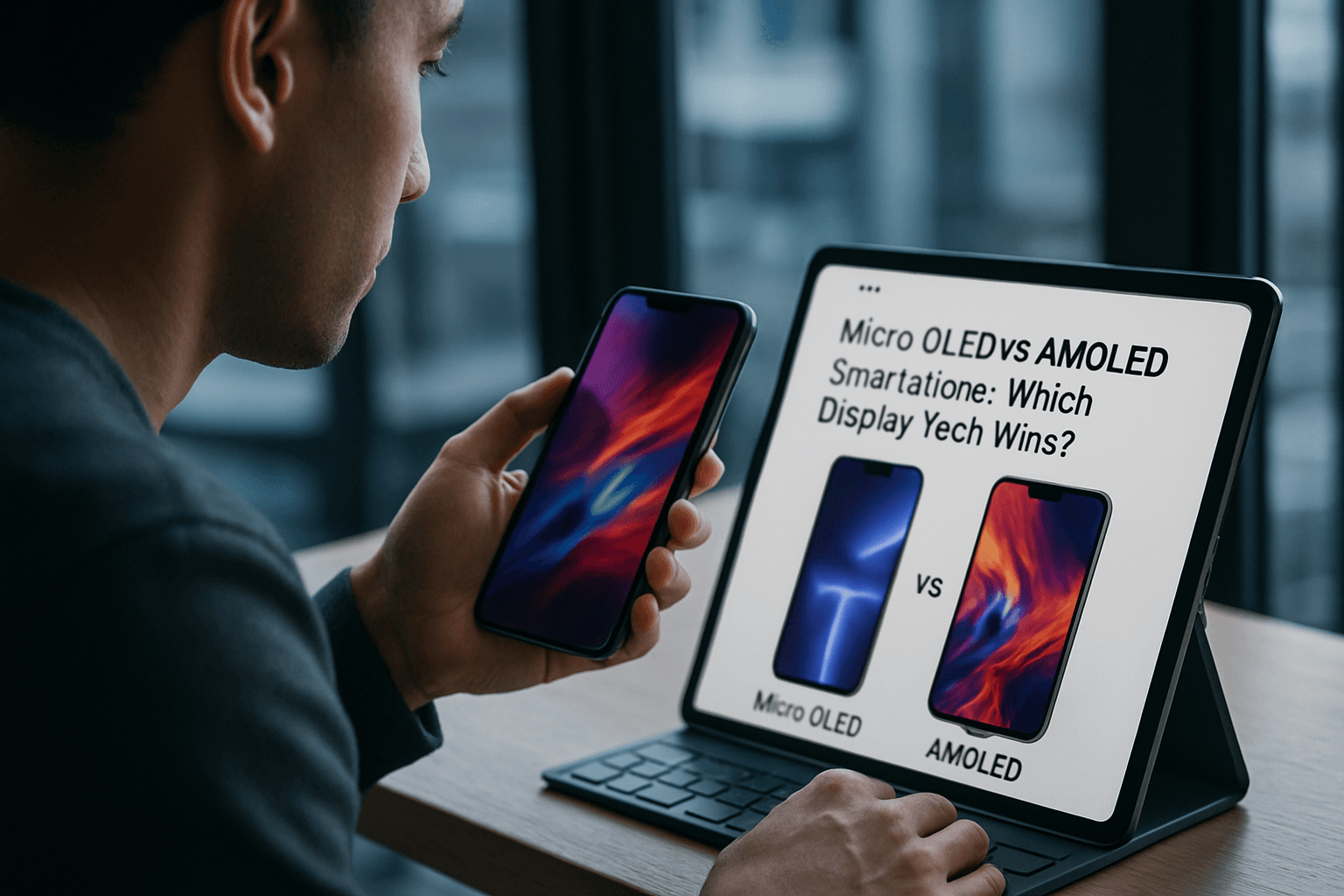
Micro OLED vs AMOLED Smartphone: Which Display Tech Wins?
What Are These Technologies?
AMOLED stands for Active Matrix Organic Light Emitting Diode, a type of display technology that uses organic compounds to produce light when an electric current is applied. AMOLED displays consist of an active matrix of OLED pixels with an additional layer of thin-film transistors (TFTs) that control the flow of electric current to each pixel.
Micro-OLED (also called OLED-on-silicon or Si-OLED) takes a different approach. Micro OLED builds pixels directly onto silicon chips, enabling ultra-dense displays like Pico 4's 1.3" panels hitting ~5,400 PPI, while AMOLED uses glass or flexible TFT backplanes, powering phones like Samsung's S24 with 6.7" screens at ~450 PPI. Micro OLED places display pixels directly onto 12-inch silicon wafers, with its pixel pitch typically between 8 to 15 micrometers, allowing the pixel density (PPI) to easily surpass 3000+.
Key Technical Differences
The architectural gap between these technologies explains much of their divergent real-world behavior. Micro OLED's silicon base is thinner than a human hair (20-30 microns), while AMOLED's glass/TFT backplanes are thicker (50-100 microns) but cheaper to mass-produce, ideal for 6-7" screens where pinching pixels isn't critical.
The silicon base isn't just structural; its high thermal conductivity (150 W/m·K, 3x glass) prevents overheating during operation, extending lifespan to 100,000+ hours (vs. ~50,000 hours for some OLEDs). This thermal advantage gives micro-OLED an edge in sustained performance, especially critical for always-on devices.
Response time is another differentiation point. Micro OLED can achieve screen response time to within 0.01 milliseconds and provides a contrast ratio exceeding 100,000:1, making it the preferred solution for achieving retina-level display effects. AMOLED is competitive but not quite at this level.
Brightness: Where AMOLED Wins
For smartphones specifically, brightness is a practical reality. AMOLED hits 1,500-2,000 nits peak (outdoor visibility), while Micro OLED maxes around 800-1,000 nits—fine for dark VR headsets but a drawback for sunlit phone use. This brightness gap is a significant limitation for micro-OLED in phone applications.
The Galaxy S26 features a 6.3" 1080x2340 120Hz 2600 nits (peak) LTPO AMOLED display. Modern AMOLED phones routinely surpass 2,000 nits, making them substantially more readable in daylight than current micro-OLED alternatives.
Cost and Feasibility
This is where the two technologies sharply diverge. Micro OLED runs 150−200 per diagonal inch (think 200+ for a 1.3" panel), making it prohibitive for phones, while AMOLED costs just 50-100 per inch, why your 800 phone gets a 6.7" screen.
The production economics are stark. AMOLED module costs hinge on size and application—a 1-inch watch panel fetches 5−8, while 6.5-inch phone modules average 15−22, with most going to the OLED panel (~60%), plus driver chips/touch layers. Building a large-format display on silicon is simply not economically viable at scale.
Current Market Reality
AMOLED is the dominant smartphone display technology today. As of March 2026, every Samsung Galaxy smartphone sold globally — from the flagship Galaxy S25 Ultra to the budget-friendly Galaxy A37 5G — features a genuine AMOLED display, specifically Super AMOLED or Dynamic AMOLED 2X technology. Global shipments of AMOLED smartphone panels are anticipated to surpass 840 million units in 2024, reflecting a remarkable growth of almost 25% from 2023, with shipments predicted to surpass 870 million units in 2025.
Micro-OLED remains confined to AR/VR headsets and smartwatches, where its compact size, low power consumption, and extreme pixel density deliver genuine value. Apple Vision Pro gets this right: its dual 0.9-inch Micro OLEDs (120Hz, 23 million total pixels) use 300mW per panel letting the headset run for 2 hours without overheating, and the 0.9-inch Vision Pro screen still hits 1800 PPI, so text looks sharp at arm's length.
Lifespan and Durability Issues
AMOLED displays have a documented durability challenge that buyers should understand. AMOLED burn-in is a form of permanent, irreversible physical degradation. An AMOLED screen's organic pixels dim at a faster rate, with a typical half-life of 30,000 to 50,000 hours (or about 4-5 years of peak performance).
That said, with typical use (about 3-4 hours daily), a quality AMOLED screen is designed to last 4 to 5 years before you might notice a significant drop in quality. Manufacturers have implemented mitigation strategies: Samsung has developed advanced pixel shifting technology for AMOLED screens to prevent burn-in, which involves subtly moving static elements on the display by a few pixels at regular intervals, and they have implemented sophisticated algorithms that detect static content and gradually reduce its brightness over time to minimize the risk of burn-in.
Micro-OLED's superior thermal performance should theoretically translate to longer lifespan, but the technology is too new in smartphone contexts to have extensive real-world aging data.
Which Is Better?
The honest answer depends entirely on application. For smartphones, AMOLED is the practical choice—and will remain so. It's bright enough for outdoor use, affordable at scale, mature in production, and proven in the market across millions of devices.
Micro-OLED delivers superior pixel density, lower power consumption, and cooler operation, but its brightness limitations and prohibitive cost make it unsuitable for the large displays smartphones demand. Its dominance in VR headsets and AR glasses reflects a rational technological matching: those devices benefit enormously from extreme pixel density and compact size, while caring far less about peak brightness.
The real story isn't which technology is universally better—it's that different applications require different solutions. AMOLED won the smartphone display war through a combination of adequate performance, manageable cost, and manufacturing maturity. Micro-OLED carved out its own niche where size, power efficiency, and extreme sharpness trump brightness. Understanding this distinction shows how display technology, like all engineering, is fundamentally about tradeoffs.