
QLED vs OLED vs Mini-LED for Streaming: Which TV Wins?
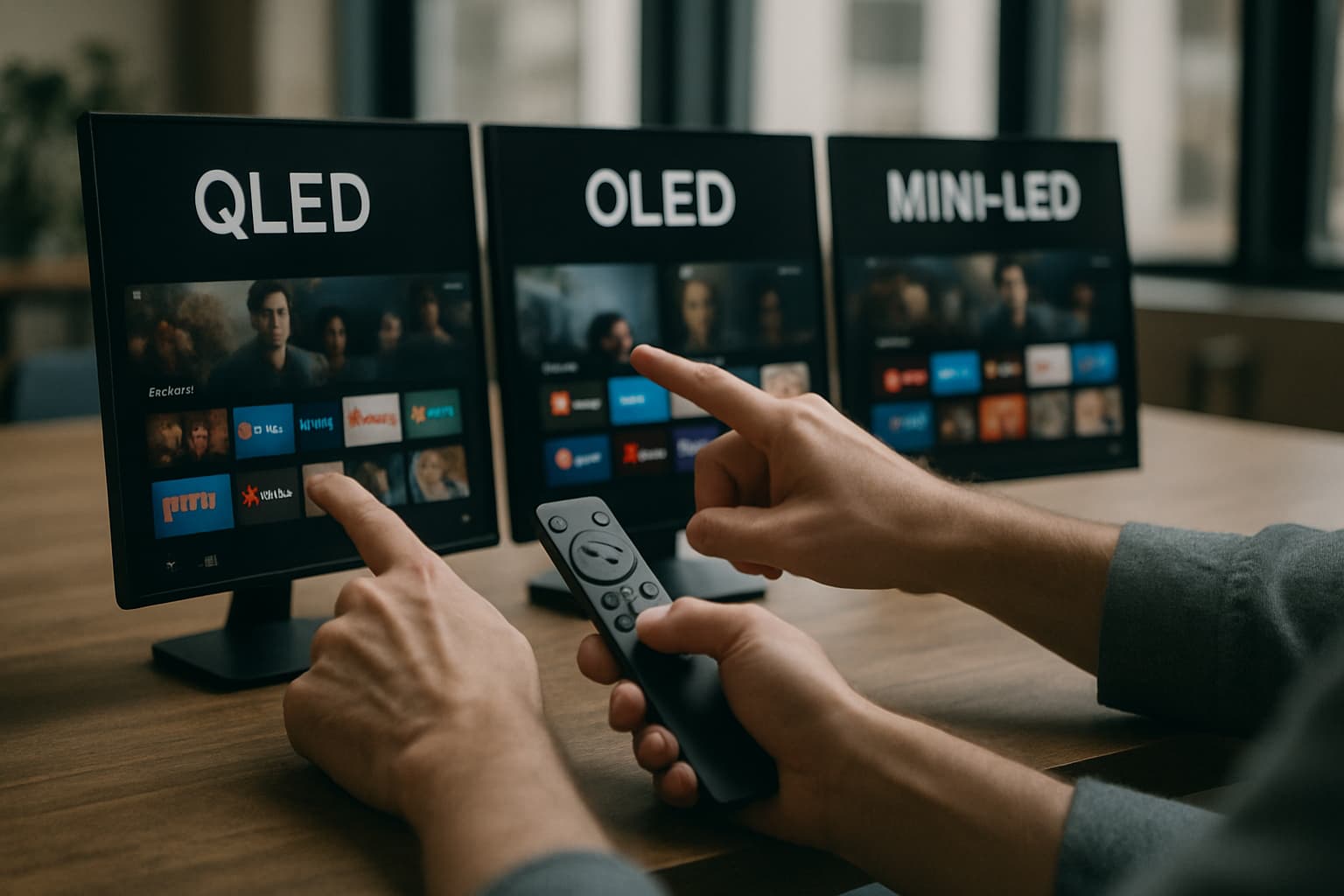
Understanding the Core Technologies
QLED TVs use an LED backlight along with a Quantum Dot layer to improve colour reproduction and brightness. The quantum dots are tiny particles that enhance color accuracy and vibrancy.
Unlike QLED and Mini LED TVs, OLED does not rely on a conventional LED backlight. Instead, each pixel produces its own light. When an OLED pixel needs to display black, it can switch off.
Mini LED TVs are also backlit displays, but use much smaller LEDs for the backlight. This allows manufacturers to use more LEDs and achieve finer control over different areas of the screen. It's worth noting that QLED describes the use of Quantum Dot technology to enhance colour, while Mini LED describes the backlighting system. A television can therefore use both QLED and Mini LED technology.
OLED: Superior Picture Quality, With Caveats
The Strengths
OLED's self-lit pixels give it exceptional control over black levels, which creates the stunning contrast OLED is known for. Unlike traditional LED and LCD TVs that rely on backlighting, OLED panels use self-lighting pixels that emit their own light. This means each individual pixel can turn on or off independently, allowing for perfect blacks and an infinite contrast ratio.
OLED technology generally offers more flexibility with viewing angles. You have to sit at quite an uncomfortable angle before colors distort, which is perfect if you can't always guarantee the best seat in the house on family movie night.
The Drawbacks
If you watch a lot of streaming, be aware of a real limitation: if you spend a lot of your time watching streaming services, then a big part of what makes OLED TVs worth their salt is being lost. It's not the fault of the TV, but it's the fault of the streaming service. Most streaming services don't match Apple TV+ upwards of 40 Mbps bitrate. For that reason, your OLED TV isn't looking as dark as it could. You'll find that thanks to this type of compression, those inky dark blacks you're supposed to be getting with your superior contrast often look gray instead of black.
OLED has lower peak brightness, which is great in dark rooms, but less punchy in daylight-bright family rooms compared to QLEDs or Mini-LEDs.
Burn-in concerns, while often overstated, still exist. Burn-in is a phenomenon where static images — like news channel logos or game HUD elements — can leave a permanent ghost image on an OLED screen. However, modern OLED TVs include pixel-shifting and screen-saver features that prevent burn-in during normal use. For typical varied viewing — streaming, movies, sport, gaming — OLED burn-in is extremely unlikely.
Pricing
OLED is the premium option. The evo C6 line ranges from $1,399 (42-inch) to $5,299 (83-inch), with a 55-inch model for $1,999, a 65-inch one for $2,699 and a 77-inch model for $3,699.
QLED: Bright, Reliable, and Affordable
The Strengths
The main advantage is the ability to produce a much higher luminance level than you would be able to get from OLED or traditional LCD display. This brightness advantage makes QLED ideal for brightly lit rooms. QLED TVs are capable of producing significantly higher peak brightness than most OLED models, allowing them to combat glare and maintain vibrant picture quality in rooms with large windows or abundant natural light. This makes QLED an excellent choice for open-concept living spaces and daytime viewing.
QLED TVs are completely immune to the image retention and more severe burn-in that can affect OLED TVs. You can play video games all day long and watch news channels 24-hours a day without having to worry about it.
The Drawbacks
One of the main disadvantages of QLED TVs is that they can't recreate the black levels of OLED units. On top of this, light bleed effects aren't uncommon with QLED TVs. This effect manifests in the form of a haze around bright objects on a screen. While the effect isn't always noticeable, when it is, the result can be lines that are meant to appear sharp appearing blurred instead.
The goal is to view a QLED screen head-on, from the center. Moving to the side or up and down can result in a diminishment in both color and overall brightness.
Mini-LED: The Middle Ground
The Strengths
Mini-LED represents the halfway point between QLED and OLED, taking the older tech and trying to approximate what the newer tech can do. Mini-LED offers noticeably better contrast than QLED or typical LCD and it may be hard to discern a difference between the contrast on Mini-LED and OLED. The deep blacks that OLED promises are essentially available with Mini-LED.
Mini-LED TVs can often exceed 2,000 nits peak brightness, a significant advantage over most OLED panels when it comes to HDR highlights in bright rooms.
With so many more LEDs, Mini LED TVs can adjust the brightness in zones (called local dimming zones). This results in deeper blacks where the light is turned off, and brighter highlights where it remains.
The Drawbacks
Mini-LED is not without compromises. An inherent drawback of mini-LED TVs is that they rely on LED backlighting to illuminate the visuals. The lack of self-emissive pixels forces them to leverage local dimming to approximate true black. Because even the most expensive mini-LED TVs have significantly fewer dimming zones than available pixels, they are unable to offer pixel-perfect light control. As a result, parts of a scene which should be dark can often have a grayish tint.
It's difficult to completely eliminate the blooming effect even on premium Mini LED TV models — this is simply a technological limitation that comes with panels that use any form of backlight. Blooming refers to the weird halo effect you can sometimes spot around bright objects that are surrounded by a dark background — think of streetlights or the moon against a dark night sky.
Mini LED technology is more expensive compared to normal LED types. Its cost is approximately 20% higher than an LCD panel.
Which Should You Choose for Streaming?
Your decision ultimately comes down to three factors: your room, your content, and your budget.
Bright, sunny rooms
Mini-LED remains the most reliable choice for most bright rooms because it combines higher sustained brightness with fewer compromises during long daytime use. If budget is tight, QLED also works well.
Dark rooms, movie-focused
OLED delivers the most cinema-like experience with its unmatched black levels and contrast—provided you watch high-quality sources. For compressed streaming, the advantage diminishes.
Mixed lighting, balanced needs
Mini LED and OLED both deliver a vivid and enjoyable experience, but each stands out differently depending on the type of environment. Mini LED's high brightness and vivid colour expression make it ideal for watching HDR content. OLED excels in producing deep blacks, making it more immersive and suitable for high-contrast content. Mini-LED offers the best compromise between these qualities.
Budget-conscious
QLED TVs use a backlighting system combined with a quantum dot layer to enhance color reproduction and provide superior picture quality. QLED TVs offer similar picture quality to OLED while typically being more affordable.
The good news is that all three technologies can deliver excellent streaming experiences. The "best" choice depends on matching the technology's strengths to your specific viewing conditions and habits.