
RTX 4070 vs RTX 4080 Gaming Performance: Complete Comparison
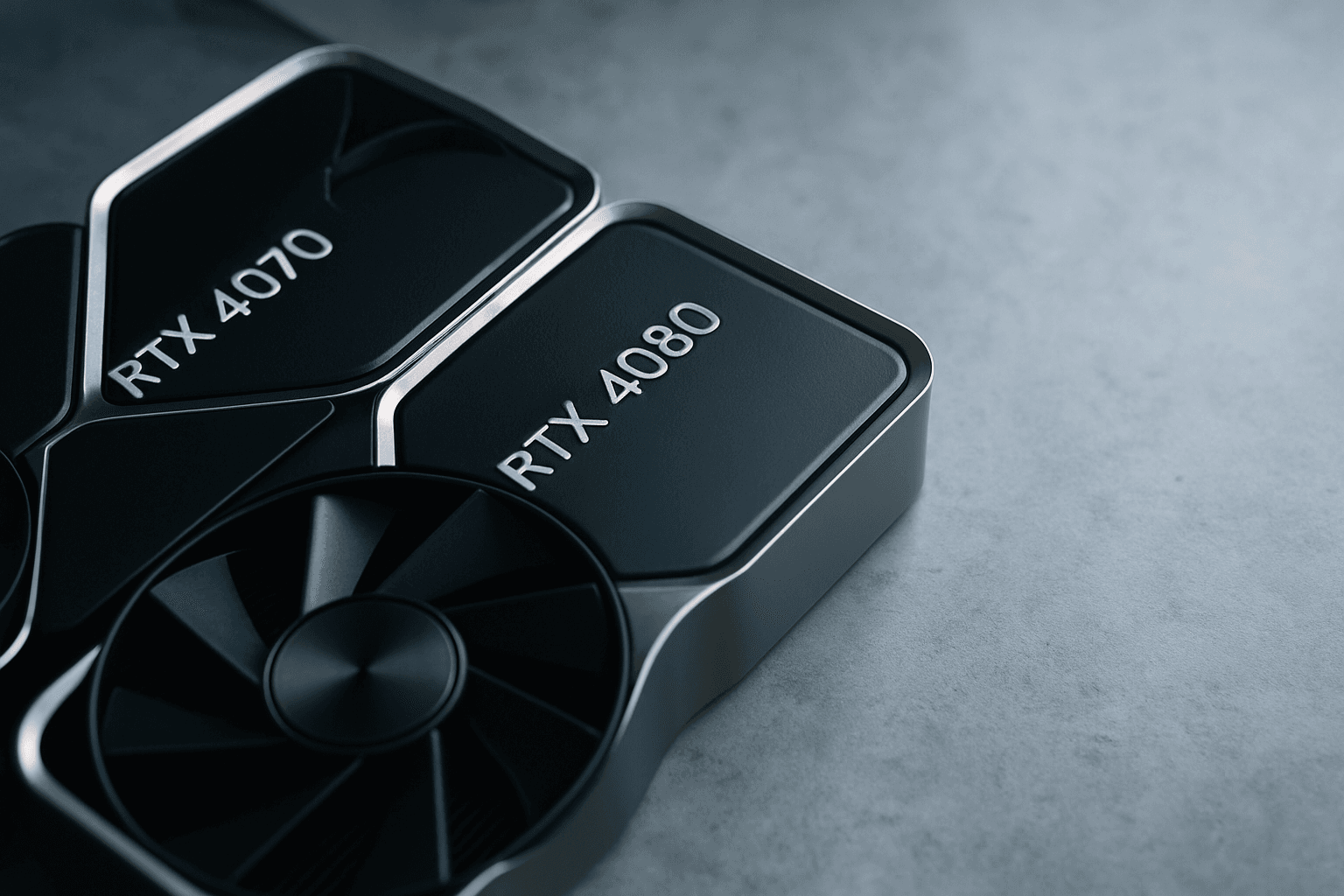
RTX 4070 vs RTX 4080: Which GPU Should PC Gamers Choose?
The RTX 4070 and RTX 4080 represent two distinct tiers in NVIDIA's Ada Lovelace lineup, each serving different gaming priorities and budgets. While both deliver strong performance with DLSS 3 support and advanced ray tracing, the gap between them widens significantly at higher resolutions. Understanding the trade-offs is crucial for making the right choice.
Core Specifications and Architecture
The RTX 4070 features 5,888 CUDA cores organized across 46 streaming multiprocessors built on NVIDIA's Ada Lovelace architecture. The RTX 4070 comes with 12GB of GDDR6X memory running at 21 Gbps across a 192-bit memory interface.
In contrast, the RTX 4080 has 16GB of GDDR6X memory with 76x RT cores, 304x Tensor cores, and 9728x CUDA cores. The NVIDIA GeForce RTX 4080 utilizes a 256-bit memory interface. This means the 4080 nearly doubles the core count and expands the memory bus substantially.
Despite the narrower bus, NVIDIA made up for it by increasing the L2 cache from 4MB to 36MB—a 9x increase. This huge cache means the GPU doesn't need to access VRAM as often.
Memory: The Hidden Advantage for 4K
The 12GB capacity is well-suited for 1440p gaming and most 4K scenarios with DLSS enabled. The RTX 4070 handles memory-intensive workloads reasonably well for its segment, but the 4080's wider memory bus, beefier GPU die, and extra VRAM start pulling real weight. The performance gap widens to roughly 30–35% in favor of the 4080.
For 4K high-quality DLSS modes, the extra 4GB buffer on the 4080 becomes meaningful in newer AAA titles with large texture sets.
1440p Gaming Performance
This is where the value proposition becomes interesting. The RTX 4070 Super shines brightest—averaging 90–120 fps in demanding AAA games at 1440p Ultra settings. The RTX 4080 Super jumps to 130–155 fps at the same settings, a real but not transformative difference for most monitors.
The question is whether those extra frames justify an extra $400–$500 for 1440p specifically. They don't. For most high-refresh 1440p displays (144Hz or 165Hz), both cards deliver excellent frame rates. The RTX 4070 is the right card for the vast majority of PC gamers. It dominates 1440p, handles power budgets gracefully, fits in nearly every case, and delivers excellent value per dollar.
4K Performance: The Turning Point
At 4K, the dynamic shifts decisively. The RTX 4080 opens up a clear lead over the RTX 4070, often landing around 30-40% faster in GPU-bound titles, especially when ray tracing is enabled. That extra performance is what lets you push Ultra presets and still keep frame rates in the 80-120 FPS range on a good 4K display.
At 4K Ultra settings without any upscaling, the 4070 drops below 60fps in demanding titles like Cyberpunk 2077, Hogwarts Legacy, and Microsoft Flight Simulator. The 4080 stays above 60fps in most of those same titles. With DLSS Quality mode enabled, the 4070 claws back into the 60–80fps range, but you're already relying on AI upscaling as a requirement rather than a nice-to-have.
Ray Tracing Workloads
The performance advantage grows even more pronounced under ray tracing loads. The NVIDIA RTX 4080 holds a dominant position in these tests, often beating the RTX 4070 by 50% or more. With ray-traced shadows enabled, the RTX 4080 is 55.5% faster than the RTX 4070. Cyberpunk 2077 increases the performance deficit between the RTX 4070 and 4080 to 69%.
This gap exists because ray tracing is significantly more taxing on GPUs, especially increasing the register and cache usage for BVH structures generation.
Power Consumption and Cooling
The GeForce RTX 4070 has a TDP of 200 Watts. The GeForce RTX 4080, on the other hand, features a higher TDP of 320 Watts, signifying its greater power requirements and thermal considerations.
The power difference becomes tangible in real-world operation. The RTX 4070 consumed around 183 watts of power on average through gaming tests at 4K, while the RTX 4080 consumed around 277 watts. This also equates to a 50% difference between the two cards.
This matters for system builds. The 4080 will demand a quality 750W–850W PSU, whereas the 4070 fits comfortably in systems with 650W supplies.
Current Pricing and Value
Pricing has shifted since launch, making value calculations clearer. The release price (MSRP) in the US was $599 at launch for the RTX 4070. The release price (MSRP) in the US was $1,199 at launch for the RTX 4080.
In current markets, at current pricing (~$599 vs ~$1,199), the RTX 4070 is the better pure value option for most gamers. On raw FPS alone, the RTX 4080 is clearly superior—but it also costs roughly twice as much as the RTX 4070 in many regions.
Which Card Should You Choose?
Pick the RTX 4070 if: You game primarily at 1440p, want strong frame rates with reasonable power consumption, or value getting high-end performance without breaking your budget. If your main target is 1440p with some lighter 4K on the side, the RTX 4070's efficiency and price make it very appealing.
Pick the RTX 4080 if: You're fully committed to 4K gaming with maximum quality settings, want rock-solid frame rates in ray-traced scenarios, or plan to keep your card for many years. If you want to drive a 4K high-refresh display for years with maxed-out settings, the RTX 4080 justifies its premium.
The 4070 often delivers better FPS-per-dollar, particularly for 1440p gaming where its performance is already excellent and the 4080's extra headroom is less critical. The 4080 becomes easier to justify if you're fully committed to 4K high-refresh gaming, want maximum eye candy and ray tracing, or plan to keep the card for many years.
Both cards share the same Ada feature set—DLSS 3, Frame Generation, Reflex, and advanced ray tracing—so your choice ultimately comes down to resolution targets and budget constraints, not feature availability.